
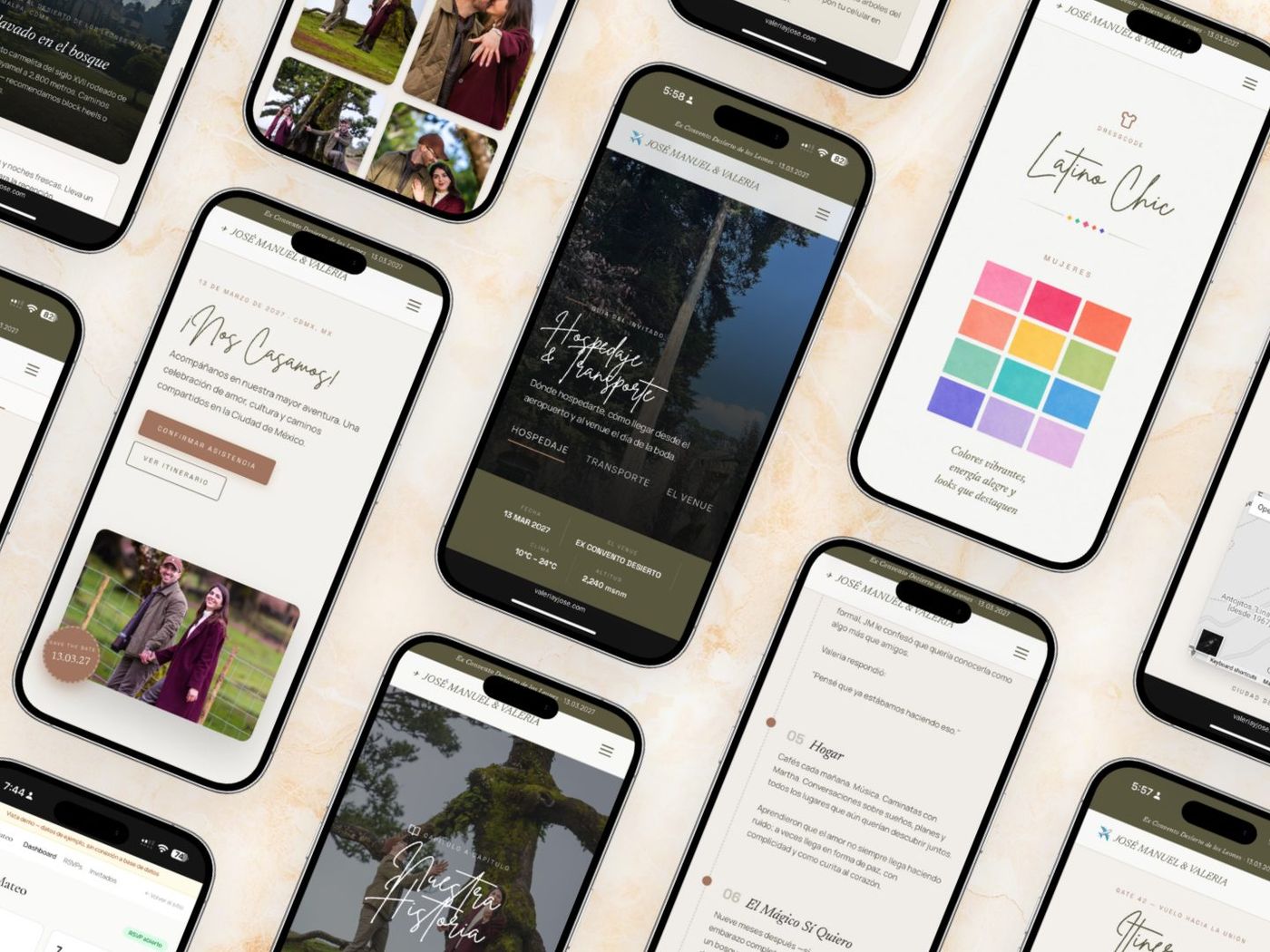
Personalised wedding website vs free template?
The financial cost may be low, but there is still a time cost. You need to learn how to use the platform, organise the content, check links and make updates.
A wedding website is more than an invitation. It brings together schedules, locations, recommendations, frequently asked questions and integrated RSVP management in one place. However, not every couple needs the same type of website.
A free template can provide a quick solution for a simple wedding. A personalised wedding website makes more sense when the design, guest management or logistics require greater care.
The right choice depends on your time, budget and type of wedding.
Quick comparison: personalised wedding website vs template
Aspect | Wedding website template | Bespoke wedding website |
|---|---|---|
Design | Predefined options used by many other couples | A design adapted to the wedding and the couple’s personality |
Setup | Two to three weeks configuring it yourself | One to two weeks with Get Ready Weddings |
Guest management | Basic, connected to an existing app such as Google Sheets, or unavailable | Unlimited guests, allergy and plus-one management, and support for multiple events |
Support | Limited, unavailable or provided through public forums | Direct support from the team designing and developing the website |
Languages | Usually unavailable | Included in selected packages |
Privacy | Depends on the provider | Option to add password protection and responsible personal data management |
Flexibility | Limited to the available content blocks | Adaptable sections and user journeys |
Time required from the couple | You must configure it and learn how to use the tools from scratch | The work is delegated and handled by Get Ready Weddings |
When is a free template enough?
A template may be sufficient when the wedding is small, takes place at a single venue and all guests speak the same language. It can also work when you only need to share basic information, such as the location, and provide a simple form.
As a general reference, a free template will often be enough when the guest list is under 50 people and you do not need a unique design. You could use tools such as Canva or Google Forms.
However, someone will still need to choose the design, upload the copy, prepare the photographs and check the mobile version. They will also need to resolve any problems with the form or guest list.
A template is a reasonable option when you enjoy handling these technical tasks and have enough time available.
A template works well for a simple need. Problems begin when the wedding stops being simple.
The design and personality of the wedding
Templates are built around a fixed structure. You can change colours, photographs and, in some cases, typefaces. Even so, the overall layout will remain very similar to the websites of other couples using the same template.
With a bespoke wedding website, the design begins with the style of the event and the personality of the couple. It can follow the same visual direction as the invitations, flowers, venue or stationery. It also allows you to decide which information should receive the most attention and how guests move through the website.
The difference becomes more noticeable when the wedding has a clear visual direction. An editorial wedding, themed celebration or destination wedding may lose part of its character within a rigid template.
For destination weddings, this difference matters even more. Save the Dates are often sent between eight and twelve months in advance because suppliers, transport and accommodation require much more coordination.
In these situations, a professional provides something a template cannot: a considered approach that maintains consistency across the design, colours, flowers and bespoke outfits, helping to avoid disconnected decisions that end up costing more than expected.
Guest management and multiple events
Free platforms often include a basic RSVP system, although some do not provide one at all. For a straightforward wedding, this may be enough. The difference appears when there are multiple events, plus-ones, menu choices, allergies or coach transfers to organise.
The turning point is usually around 100 guests. From that point onwards, managing confirmations, creating table plans, keeping family groups together and finding suitable seats for individual guests becomes much more complicated. There is also greater room for error when everything is managed manually or through basic tools.
A personalised website can connect responses to a private dashboard. You can quickly see who has confirmed, which menu they selected and whether they need transport.
This is especially useful for destination weddings, celebrations with more than 100 guests and weddings held across several days.
What couples say
“Working with them was an incredible experience. Fast, efficient and with very smooth communication. They understood exactly what we wanted and brought it to life perfectly. All our guests loved it! You really get what you pay for. I'd recommend them to any couple who wants to stand out.”
Support and time required
With a template, the couple builds and maintains the website.
The financial cost may be low, but there is still a time cost. You need to learn how to use the platform, organise the content, check links and make updates. Free templates in Google Docs, Sheets or Excel can help with basic tasks such as lists, budgets and planning. However, they remain limited to whatever you are able to build and maintain yourselves.
When the project is delegated, someone else handles the design, configuration, testing and agreed updates. You also have a direct contact when something stops working or plans change.
Alongside the website itself, a professional may help you coordinate with technology providers and avoid exceeding the budget you originally set.
The question is not only how much the website costs. You should also consider how much time you want to spend on it during the months before the wedding.
This can make a significant difference when you are already coordinating suppliers, payments, guests and travel arrangements.
Privacy and control of personal data
A wedding website contains names, schedules, locations and guest responses. You should check where this information is stored, who can access it and whether the website can appear in search engine results.
Many template providers allow you to add a password or hide the website. However, the available options vary between platforms. Some services also display their own branding or integrate third-party tools.
A bespoke private website can be configured to prevent indexing, control access and collect only the information that is genuinely needed. This becomes more important when the guest list includes public figures, the wedding takes place at a private location or the website contains sensitive information.
Flexibility and updates
Templates work within a predefined catalogue of features. When the section you need already exists, you can use it. When it does not, you will need to find another solution or adapt your original idea.
A personalised website can include dedicated sections for:
Hotels
Transport
Restaurants
Gifts
Activities during the stay
Event-specific questions
The website can also grow alongside the wedding. It may begin as a Save the Date announcement and later add the RSVP form, schedules and guest guide.
Which option is right for you?
Choose a template when the wedding is straightforward, the budget is limited and you can spend a few hours setting everything up. You will receive a useful website without making a large investment.
A personalised wedding website is a better fit when you want a unique design, multiple languages, several events or clearer guest management. It can also be worthwhile when you prefer to delegate the digital side of the wedding and receive support until the event.
The best option is the one that reduces your workload without adding more complexity.
If your wedding has more than 100 guests, Get Ready Weddings can design a bespoke wedding website with integrated RSVP management, a private dashboard and CSV data exports. You can delegate this part of the planning and reduce the time, stress and repeated messages involved.
When guests are travelling from abroad or speak another language, we can also add destination wedding or bilingual wedding website features to the same project.
Book a call or message us on WhatsApp to discuss your questions.
Frequently asked questions
How much does a personalised wedding website cost?+
The price depends on the design, languages, number of events and required features. A simple template-based website may be free. A bespoke service requires a larger investment because it includes design, configuration, testing and support.As a general reference, a free template may cost between €0 and €50, while a bespoke service will often start from around €500, depending on the scope of the project.
Can I start with a template and change later?+
Yes, although transferring copy, responses and guest data may require manual work. When you expect the wedding to involve complex logistics, it is better to define your requirements before opening the RSVP.
Can a personalised website use a custom domain?+
Yes. You can use an address such as yournames(.)com. Some providers also offer a subdomain within their own website.
Can the website be password-protected?+
Yes. It can also be hidden from search engines, and access to certain content can be limited according to each guest group.
What information should it include?+
At a minimum, it should include the date, schedule, venue, map, dress code, RSVP form and frequently asked questions.For destination weddings, it is also helpful to include hotels, transport, restaurants and travel advice.